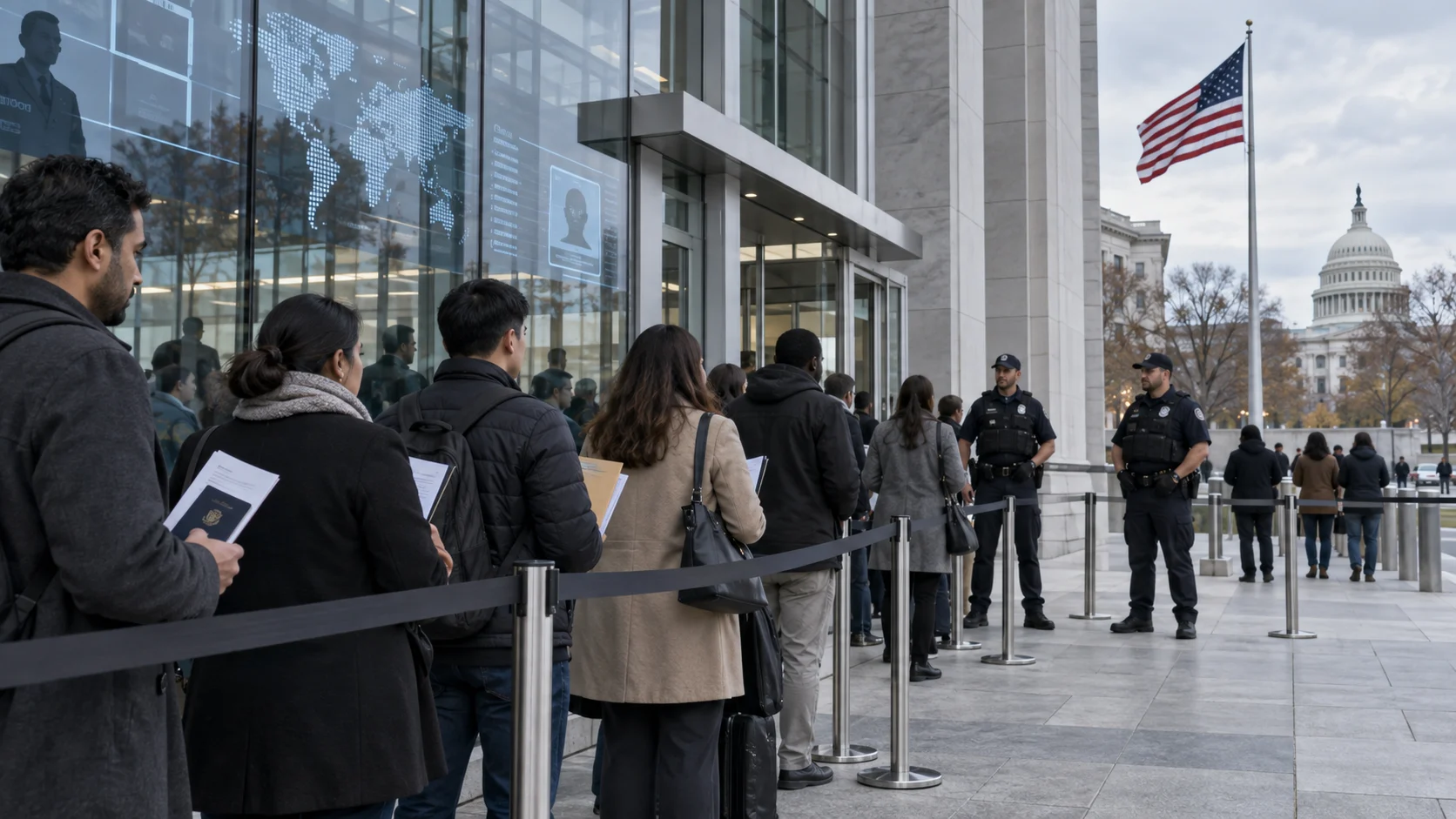
The United States is experiencing a sharp expansion of immigration enforcement under President Donald Trump’s second administration. The policy shift combines record levels of arrests by U.S. Immigration and Customs Enforcement, broader information-sharing expectations for state governments, increased detention, intensified visa screening, and large-scale revocation of previously issued visas.
The administration describes these measures as necessary to enforce federal immigration laws, strengthen national security, protect public resources, and remove foreign nationals who violate immigration requirements. Civil-rights organizations, immigration attorneys, state officials, and community advocates have raised concerns about privacy, due process, family separation, government surveillance, and the effect of enforcement operations on people without criminal convictions.
ICE Reports Record Arrests
The Department of Homeland Security reported that ICE arrested 50,925 people nationwide in August 2026, surpassing the previous monthly record of 50,208 arrests established in July. These figures demonstrate the rapid growth of enforcement operations across workplaces, homes, courthouses, transportation locations, and communities. DHS described the August total as a new record.
The administration has expanded enforcement beyond individuals convicted of serious crimes. ICE operations may also target people with final removal orders, immigration violations, expired authorization, pending cases, or other issues affecting their legal status. Independent detention data show that many people held in ICE custody do not have criminal convictions, although the government distinguishes immigration violations from criminal offenses when explaining its enforcement priorities.
Federal authorities have also expanded cooperation with local law-enforcement agencies through immigration agreements and information-sharing programs. Supporters say these partnerships allow agencies to identify removable individuals more efficiently. Critics argue that involving local police in federal immigration enforcement could discourage immigrant communities from reporting crimes, seeking medical assistance, cooperating with investigations, or participating in public services.
States Face New Reporting Expectations
The Justice Department has issued a new legal interpretation stating that states participating in certain federal welfare programs must report individuals they know are not lawfully present in the United States to the Department of Homeland Security. The opinion applies the reporting obligation across state government rather than limiting it to the agencies directly administering Temporary Assistance for Needy Families or Supplemental Security Income.
According to the Justice Department, states accepting the relevant federal funding must comply with the reporting requirement. The department’s interpretation replaces a narrower 1998 position and could affect universities, motor-vehicle departments, health and human-services offices, licensing organizations, and other state agencies that encounter immigration-related information. The Justice Department published its explanation of the reporting obligation.
The policy could create significant operational and legal questions for states. Agencies may need to determine what qualifies as reliable knowledge of unlawful presence, which records can be shared, how reporting will be performed, and what privacy protections apply. States may also challenge the federal interpretation, particularly if they believe it conflicts with state privacy laws, constitutional protections, funding conditions, or administrative requirements. Reuters reported that states could risk federal funding if they refuse to comply.
Visa Revocations Exceed 175,000
Immigration enforcement is also affecting legal travel and visa programs. The State Department announced in August that it had revoked more than 175,000 visas since President Trump returned to office. The department said the revocations involved criminal activity, threats to public safety or national security, visa violations, immigration-law violations, and other findings identified through government screening.
Visa revocation does not necessarily mean every affected person entered the United States unlawfully. A visa is a travel document used to request admission, while a person’s immigration status inside the country is governed separately. The consequences can therefore vary depending on whether the visa holder is outside the United States, already present in the country, maintaining valid status, or involved in immigration proceedings.
The administration has also increased continuous screening of visa holders. Law-enforcement records, immigration histories, publicly available information, social-media activity, and other government data may be considered during reviews. The State Department says these checks help identify people who no longer qualify for their visas. Critics have questioned whether some reviews provide sufficient notice, reliable evidence, and a meaningful opportunity to challenge errors. The State Department announced the 175,000 revocation figure, while Reuters provided additional reporting on the enforcement campaign.
Legal Immigration Faces Added Uncertainty
Earlier in 2026, the administration paused immigrant-visa issuance for nationals of 75 countries while reviewing public-charge screening. That action did not suspend every visa category worldwide, and it generally focused on immigrant visas rather than all temporary visitor, student, or employment visas. A federal court later vacated the blanket pause, demonstrating how quickly immigration policies can change through litigation and agency guidance.
Legal immigrants, students, skilled workers, visitors, sponsoring families, and employers may still experience longer processing times, additional document requests, enhanced interviews, expanded security reviews, or uncertainty about international travel. People with valid visas may also face renewed scrutiny after issuance because a visa can be revoked when the government receives information that it believes affects eligibility.
Wider Effects Across Communities
The enforcement expansion has consequences beyond individual immigration cases. Employers may face workforce disruptions and greater pressure to verify employment authorization. Universities may need to provide additional guidance to international students. State and local agencies may have to revise privacy, reporting, records-management, and employee-training procedures.
Immigrant families may also become reluctant to use schools, healthcare programs, emergency services, courts, or public-benefit offices if they fear that their information could be shared with federal authorities. State officials must therefore balance federal reporting expectations with applicable privacy laws, civil-rights protections, public-safety responsibilities, and the need to maintain community trust.
The administration’s actions represent a broad effort to connect immigration enforcement with federal databases, state records, local law enforcement, visa screening, and public-benefit programs. Supporters view this coordination as overdue enforcement of existing laws. Opponents see it as an aggressive expansion of federal authority that could affect lawful immigrants, mixed-status families, state institutions, and people mistakenly identified through incomplete records.
As policies continue to change, affected individuals should verify information through official government sources and avoid relying only on social-media reports. Anyone facing arrest, detention, visa revocation, removal proceedings, or uncertainty about immigration status should consider seeking advice from a qualified immigration attorney or an accredited legal-services organization.